

Vodka, Orwell, and the Ambulance of History
What my Black friends, Grenadian rum, and a Costco receipt taught me about the polite persistence of prejudice.

If you believe in free speech—not the slogan, but the dangerous, untamed variety—then subscribe to support uncensored, heretical writing. Every paid subscription buys more time to write without asking permission from the sort of people who think “problematic” is an argument.
Please subscribe to receive at least three pieces /essays per week with open comments. It’s $6 per month, less than USD 4.
Everyone says, “Hey, it’s just a cup of coffee,” but please choose my coffee when you come to the Substack counter. Cheers.

The Residue of Empire: A Short Meditation on Race, Hypocrisy, and Friendship
Let me begin by invoking the shade of George Orwell, that chronicler of empire’s hypocrisies, who in Burmese Days and “Shooting an Elephant” saw what most of us still refuse to confront: that the moral rot of racism is not simply hatred, but performance.
The imperialist, Orwell wrote, becomes a prisoner of his own mask — forced to play the tyrant lest he appear weak before the very people he dominates. He must continue the farce even as it corrodes his soul.
And now, in our self-congratulatory age of hashtags and virtue-signalling, racism has not vanished — it has merely changed costume. It wears better manners and softer shoes. It calls itself “equity” and “awareness,” adjusting its tie in the mirror while insisting it has reformed.
But as Hitchens would say, the beast is not dead — it merely learned to hold its fork properly.
The contemporary version of prejudice is bureaucratised and polite. It hides behind human-resources seminars, institutional jargon, and euphemisms like “inclusivity initiatives,” as though PowerPoint could cure discrimination. It thrives on plausible deniability — that dim moral twilight where we congratulate ourselves for not being as barbaric as our ancestors, yet still treat one another as archetypes rather than individuals. Orwell would have recognised this at once: empire reborn through paperwork, its whip replaced by a wellness memo.

But abstractions can only go so far. Let us descend into the messy particulars of life — the anecdotes, the laughter, the bottles of rum, and the quiet humiliations that reveal far more than manifestos.
The Ambulance and the Parable
I have a black friend — let’s call him Steve — a name so pale it could be a pseudonym in a bad Cold War novel. He’s a paramedic, the sort who’s too intelligent for his own good and too honest for anyone’s comfort. He drinks my liquor without apology and starts arguments with the words, “Really? How do you know that? Could you show me the evidence?” He floods my house with Soca music, so I retaliate with Queen—a sort of cultural détente.
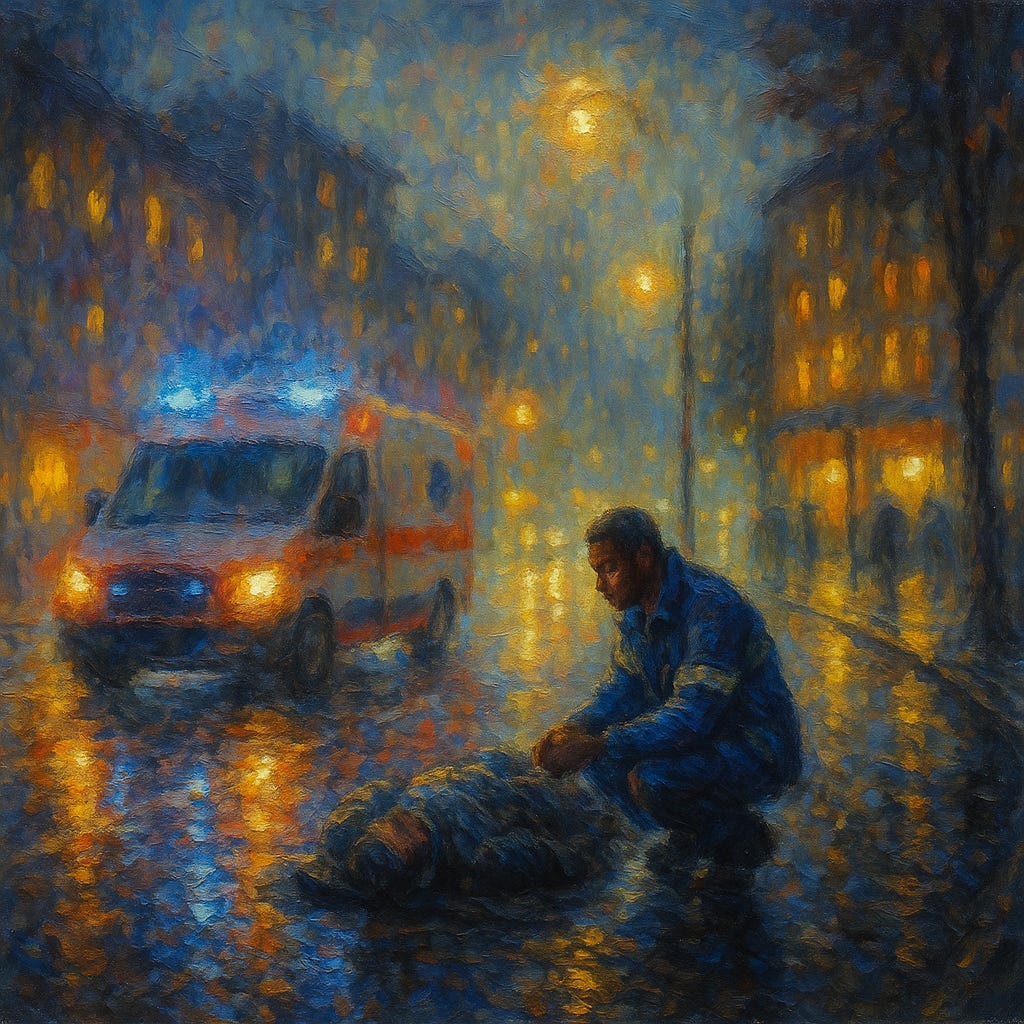
But Steve once gave me an analogy so sharp Orwell himself might have stolen it. “Imagine,” he said, “you’re bleeding out on the pavement. The ambulance arrives 30 minutes late. As you fade into the back, the cheerful paramedic leans over and says, ‘You should be grateful — eighty years ago you wouldn’t have had painkillers this good.’ Then he pats himself on the back while you die.”
That, he said, is modern racism — the moral placebo of progress. Look how far we’ve come, they say, as though the measurement of pain should comfort the dying. It’s the same logic empire used to justify its own savagery: “Be thankful for the railways, old boy, and never mind the famine.”
Governments should outlaw those “You should be grateful” pills. They numb compassion and excuse complacency. If suffering is measured only by comparison, then only one person in the world — the most miserable — has any right to complain.
The Residue of Politeness
We flatter ourselves that the old vulgar racism — the slurs spat like bullets — is gone. Not so. Steve has been called the N-word three times in the course of saving lives. Drunks, addicts, crash victims — in their delirium, the tongue loosens, and the truth seeps out. And what does Steve do? He patches them up. He saves their lives. “You’re welcome,” he tells me afterwards, with a shrug that contains both forgiveness and fatigue.
Orwell would have understood this contradiction — performing one’s duty while loathing the moral theatre that demands it. But unlike the imperial officer, Steve’s act is not one of domination but defiant decency. He responds to hatred with skill and professionalism. He lives the sermon others merely post about.
The Aisle and the Glance
Then there’s Janet — another friend whose pseudonym she’ll despise for sounding like a 1950s homemaker. I’ve shopped with her half a dozen times — twice at Costco, several more at the liquor store. She’s elegant and poised, and I, by contrast, am a fashion catastrophe. A Russian acquaintance calls my aesthetic “homeless chic,” which in Russian is considered polite.
Once, at Costco, Janet, in her office attire and I, in my dog-food-making sweats (but it’s very nutritious dog food), approached the exit for the ritual receipt inspection. She endured a thirty-second inquisition over her popcorn bags while I received a smiley face and a wave. I waited by the tire centre, feeling the slow burn of belated awareness.
At the liquor store, the pattern repeated: I was offered help; she was followed. It was not overt hostility but the quiet calculus of suspicion. The difference between inquiry and scrutiny. Between civility and surveillance.
The irony? Janet once worked for me. I tease her for her maddening honesty — for refusing to round up her hours and for sending e-transfers that end in 12 cents. If corruption had a vaccine, she’d be the booster shot.

Rum and Revelation
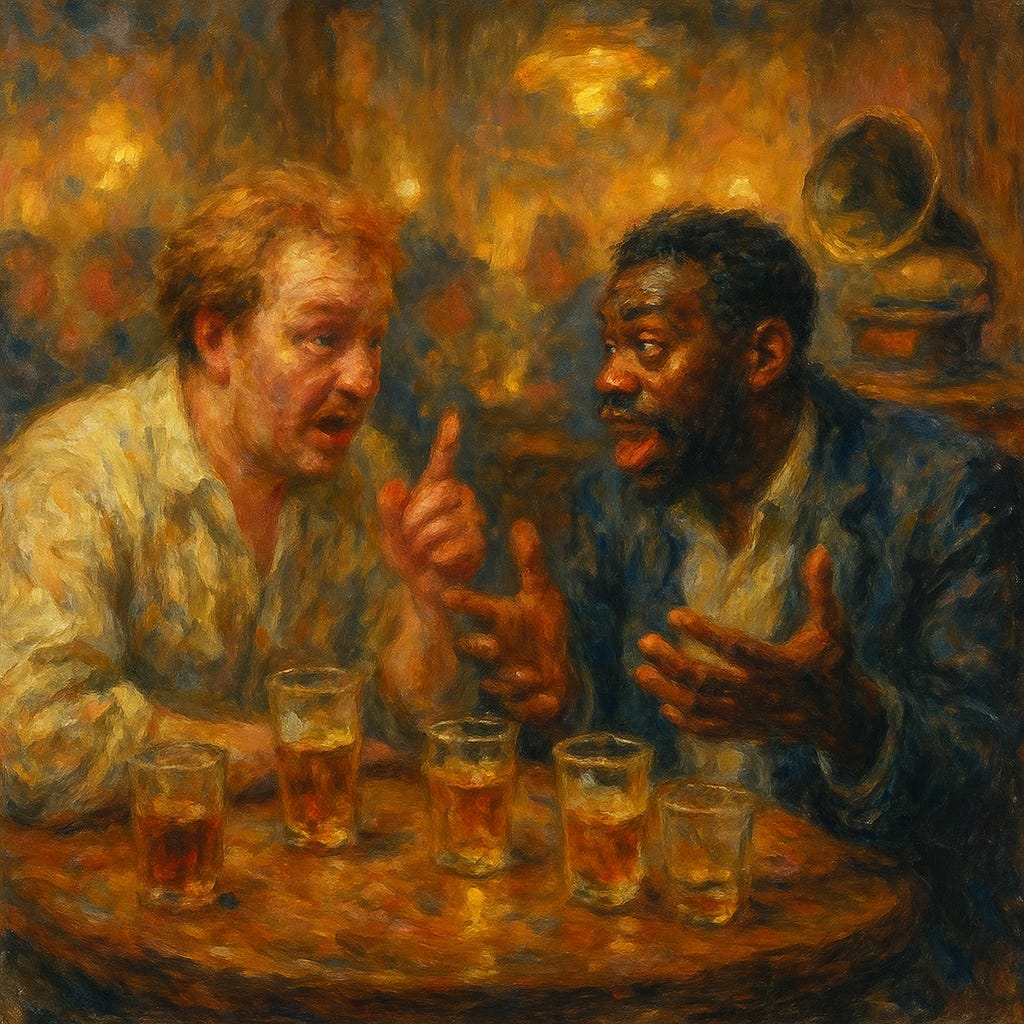
Years ago, Janet and Steve coerced me into trying a double shot of Grenadian rum so potent it could strip paint. I nearly met my Maker. They tried to revive me by blasting Bryan Adams and The Tragically Hip — a medical procedure never endorsed by science. I staggered into the parking lot to empty both stomach and pride. It was not my finest hour, but still less humiliating than the quiet degradations they endure sober.
On Diversity, Bureaucracy, and the White Saviour Complex
Now, I must confess: I have a near-allergic reaction to diversity training sessions — those mandatory ceremonies of moral self-flagellation, often led by middle-aged white saviours whose sole interaction with minorities involves renewing a driver’s licence.
I once wrote business plans for Indigenous entrepreneurs in Fort McMurray and attended a few powwows, but I’d be a fraud to claim I understand their lives. My only advantage is that I know I don’t.
Orwell would call that the first step toward decency.
But the DEI industry has become its own parody — a perpetual-motion machine of grievance and profit. It thrives on conflict, the way the empire thrived on “civilising missions.” racism was ever truly solved, these consultants would be out of work by Monday.
Strife, after all, pays better than peace.
Hitchens, no doubt, would eviscerate the lot of them — those “beagle-like sniffers of racism,” as I’ve seen them, sniffing every conversation for a whiff of heresy. They cry “You’re racist!” not to enlighten but to exalt themselves. Their condemnation is a mirror in which they admire their virtue.
The Classroom and the Joke
One of my students — let’s call her Tara, a Black Christian woman of exceptional intelligence — once pulled me aside after class. While I’d stepped out for coffee, another student had hacked into my computer, filmed the exam questions, and AirDropped them to the entire class. She couldn’t abide the dishonesty and confessed. I rewrote the exam overnight. The class average dropped to 65%. Justice served.
In that very term, Tara and her Indigenous counterpart surged to the pinnacle of our class of fifty-five, claiming first and second place with the effortless audacity of merit unchained.
I couldn’t resist the quip: “A Black and an Indigenous student seizing the top spots? I’d best consult the administration—such a thing might be verboten in these enlightened times.”
It was satire, naturally, a barb aimed at the absurdities of our age’s inverted pieties; but satire, like all sharp instruments, proves lethal only when mishandled by the dull-witted, whereupon bureaucracy unsheathes its own blades with relish.
In the end, my dismissal came not from jest but from a stark assertion: labelling Hamas as Nazis, a designation not of hyperbole but of historical precision, where the cold malignancy of fact eclipses any need for irony.
I am not “woke.” I make jokes that teeter on the edge of HR infractions. But humour, as Orwell and Hitchens both knew, is civilisation’s last defence against tyranny — the refusal to surrender irony to the mob.
On Privilege and the Heart’s Overflow
Racism, at its core, is a cardiac condition. “Out of the overflow of the heart,” says Scripture, “the mouth speaks.” Today we have dammed that overflow somewhat — the words are filtered, the bile rebranded — but the current still runs beneath.
White fragility? It’s the panic that sets in when someone suggests that silence is not innocence. White privilege? It’s not a membership card; it’s the unexamined buoyancy that carries us through life without our noticing the current beneath.
We paste Black Lives Matter stickers on our laptops and congratulate ourselves on awareness while still unconsciously walking through doors that others must batter down.
The False Prophets of Progress
Racism’s modern apostles, whether on the left or right, share a common failing: they mistake theatre for therapy. The corporate workshop, the Twitter mob, the viral apology — all are rituals of moral reassurance that achieve nothing.
The goal should be honest conversation — not ideological performance. But we fear that more than hatred itself. We prefer hashtags to dialogue because hashtags don’t argue back.
The Hope and the Humour
Yet hope persists, faint but real. Perhaps Steve’s children will never be called the N-word. Perhaps Janet’s daughters will shop unshadowed by suspicion. Perhaps that young Black lawyer will drive home without being stopped for the crime of existing behind the wheel of a nice car.
It won’t happen through DEI workshops or social media sermons. It will happen through something unfashionable and difficult — friendship, humour, and the Orwellian courage to face unpleasant truths without euphemism.
The Last Word
If Orwell were here, he’d remind us that moral progress is measured not by the distance between epochs but by the distance between intention and reality. And Hitchens, glass in hand, would growl that the antidote to racism is not guilt but honesty — not genuflection but candour.
So here’s my confession: I am a flawed man, a sloppy dresser, a satirist with bad timing, and a student of human absurdity. But I have been blessed with friends who show me, daily, what decency looks like under pressure.
Racism, like empire, survives in the shadows cast by our vanity. To defeat it, we must drag it into the light — even if that light exposes our own faces.
Orwell might call that truth.
Hitchens would call it courage.
And Steve — bless him — would just roll his eyes, pour another drink, and say,
“Really, really — can you show me the evidence?”
If you value this work, consider leaving a tip. It’s cheaper than therapy, less pious than public broadcasting, and the only censorship here is my bad taste. On second thought, it’s bad therapy.

“I'm not qualified to be a diversity consultant; I honestly believe white people should try and avoid such roles as they can be painfully annoying.”
I think such roles are painfully annoying regardless of who is in them. I pine for earlier days when people tried to put racism aside. Now the thrust is toward tribalism and race distinctions in many forms.
Please don't talk to me until u identify your tribe Jim. Thank u. 😂😂😂